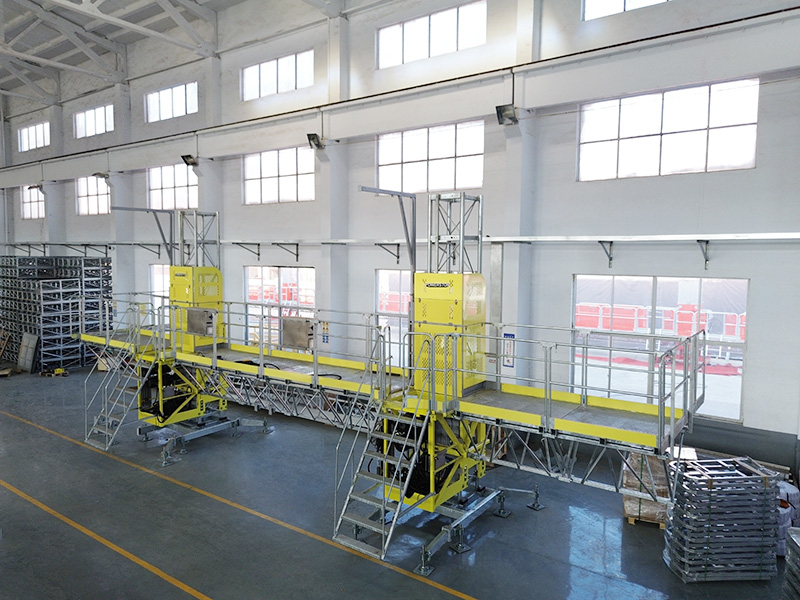
Passenger Hoists & Construction Material Lifts: Features, Applications And Industrial Value
1. Overview of Passenger and Material Hoists
Passenger and construction material hoists refer to a category of professional vertical lifting machinery specially developed for on-site industrial and construction operations. Distinct from conventional civilian elevators that are designed for fixed building environments and daily passenger transportation, this integrated lifting system is engineered to undertake dual functional tasks: the safe vertical conveyance of construction personnel and the efficient transportation of various building materials, construction tools and engineering supplies. As core auxiliary equipment for vertical logistics and personnel mobility in engineering projects, it fills the gap between general elevators and single-function material lifting devices, delivering dual practicality and on-site adaptability.
2. Core Structural and Operational Advantages
The most prominent feature of
passenger and material hoists is their dual-purpose design tailored for harsh working conditions. Traditional lifting equipment is usually limited to single cargo transportation and prohibits personnel carrying, while civilian elevators cannot withstand the complex, high-intensity operation of construction sites. In contrast, integrated passenger and material hoists adopt reinforced mechanical structures, anti-wear transmission systems and stable load-bearing frameworks, which enable them to maintain stable operation under frequent start-stop cycles, variable load conditions and long-duration working hours.
In terms of safety configuration, this type of hoist is equipped with professional industrial safety protection mechanisms, including overload protection, emergency braking systems, anti-fall devices and limit height switches. These standardized safety designs effectively eliminate potential risks caused by complex on-site environments, ensuring the personal safety of workers and the integrity of transported materials during vertical lifting operations. Meanwhile, its adjustable operating speed and flexible load range further improve the overall operational efficiency of construction sites.
3. Wide Industrial Application Scenarios
Thanks to its superior environmental adaptability and multi-functional performance, passenger and material hoists are widely applied in high-demand and harsh working scenarios beyond ordinary building construction. In urban construction projects such as high-rise buildings, residential complexes and commercial buildings, they serve as the primary vertical transportation equipment for on-site workers and concrete, steel structures, decorative materials and other construction supplies, greatly shortening material handling cycles.
Beyond conventional construction, the equipment demonstrates outstanding applicability in heavy industrial fields. In power plant construction and maintenance projects, it adapts to high-altitude operation and complex spatial environments to transport maintenance personnel and heavy mechanical accessories. In mining engineering, it meets the vertical transportation demands of underground and surface construction with reliable anti-dust and anti-corrosion performance. Additionally, in chemical industrial parks and large-scale industrial infrastructure projects, its stable and enclosed lifting structure avoids safety hazards caused by special industrial environments, supporting the smooth progress of high-standard engineering operations.
4. Industrial Significance and Development Value
The popularization of passenger and material hoists has optimized the traditional vertical operation mode of the construction and industrial engineering industries. Compared with separate configuration of passenger elevators and material lifting equipment on construction sites, the integrated dual-purpose hoist effectively reduces equipment procurement and maintenance costs, saves on-site layout space and improves the utilization rate of mechanical equipment. For large-scale, long-cycle and high-intensity engineering projects, it significantly boosts overall construction progress and standardized on-site management level.
Furthermore, with the continuous upgrading of industrial construction standards and safety specifications, modern passenger and material hoists are constantly optimized in terms of intelligent control, energy conservation and environmental protection, as well as operational intelligence. They have become indispensable core mechanical equipment for modernized, standardized and safe construction in the engineering industry, providing solid mechanical support for the efficient and high-quality completion of various industrial and construction projects.