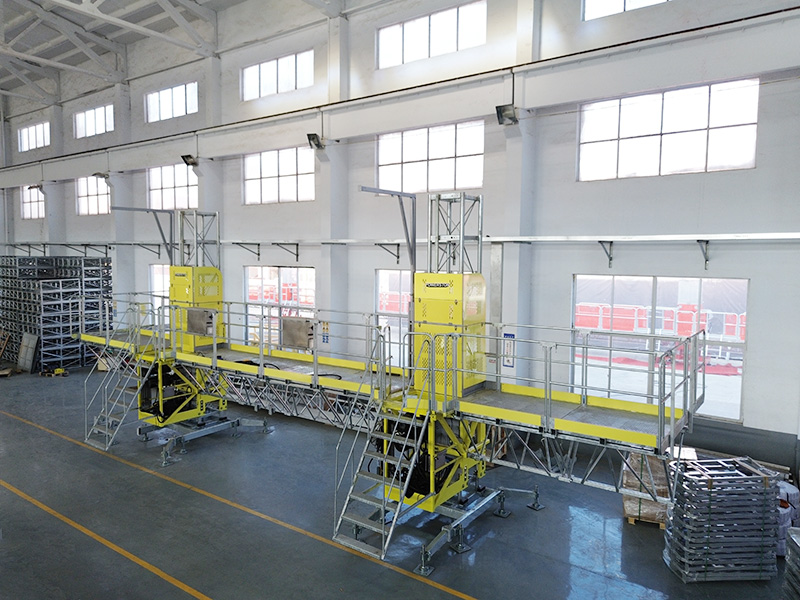
Mobile Lifting Platform Vehicle: Mechanical Structure, Working Principle And Industrial Application
A mobile lifting platform vehicle is a versatile hydraulic aerial working machine designed for vertical height adjustment and material handling. Classified as one of the most common mobile aerial work platforms, it adopts a scissor-type mechanical structure and hydraulic driving system. Featuring flexible mobility, stable lifting performance and simple operation, this equipment can carry personnel and goods to complete high-altitude operations. It is widely used in factory workshops, warehousing logistics, municipal maintenance and construction engineering, becoming essential general-purpose mechanical equipment for modern industrial production.
1. Basic Structural Composition
The
lifting platform vehicle consists of four core modules: scissor mechanical frame, hydraulic transmission system, mobile walking mechanism and intelligent safety device. The scissor support frame is welded with high-strength manganese steel to ensure structural rigidity and compression resistance. The hydraulic station, oil cylinder and sealing components provide stable lifting power. The bottom universal walking wheels and traction handle enable flexible movement on flat ground. In addition, it is equipped with anti-slip platform plates, safety guardrails, emergency stop buttons and hydraulic anti-explosion valves to prevent sudden dropping during operation.
2. Working Principle and Operation Flow
The lifting process relies on hydraulic transmission and mechanical linkage. When the equipment starts working, the hydraulic station pressurizes the hydraulic oil and pushes the oil cylinder to stretch. Under the thrust force, the scissor support arms slowly expand to realize vertical rising of the platform. By adjusting the electromagnetic valve, the oil return flow is controlled to achieve stable descending speed. During movement, the walking wheels realize free displacement. Once encountering power failure or hydraulic pipeline damage, the one-way buffer valve can lock the oil circuit instantly to avoid accidental falling, ensuring the safety of personnel and cargo on the platform.
3. Core Performance Advantages
Compared with other lifting equipment, mobile lifting platform vehicles have obvious industrial advantages. Firstly, the integrated scissor structure ensures strong stability without shaking during high-altitude operation. Secondly, the hydraulic lifting system features low noise and smooth speed conversion. Thirdly, the flexible moving design does not require fixed installation, which improves site utilization. Moreover, the equipment has strong load-bearing capacity, low maintenance cost and high safety redundancy. It can adapt to complex working environments such as indoor workshops, outdoor roads and warehouse storage areas.
4. Typical Industrial Application Scenarios
Lifting platform vehicles cover a wide range of industrial fields. In manufacturing workshops, they are used for equipment assembly, pipeline maintenance and high-altitude debugging. In logistics and warehousing, the equipment assists in cargo stacking, loading and unloading goods. In municipal engineering, it completes street lamp replacement, billboard maintenance and building decoration. In addition, it is commonly applied in exhibition halls, airports, warehouses and construction sites to provide safe and convenient aerial working conditions for operators.
5. Conclusion and Development Trend
With the continuous upgrading of industrial automation, mobile lifting platform vehicles are developing toward intelligent control, energy saving and lightweight design. Electric driving, automatic walking and intelligent obstacle avoidance functions have gradually become mainstream configurations. High-strength alloy materials further reduce self-weight while improving structural stability. In conclusion, the mobile lifting platform vehicle is an efficient and convenient aerial handling device. Its simple structure, flexible mobility and reliable safety performance make it indispensable general machinery in modern industrial and municipal fields.