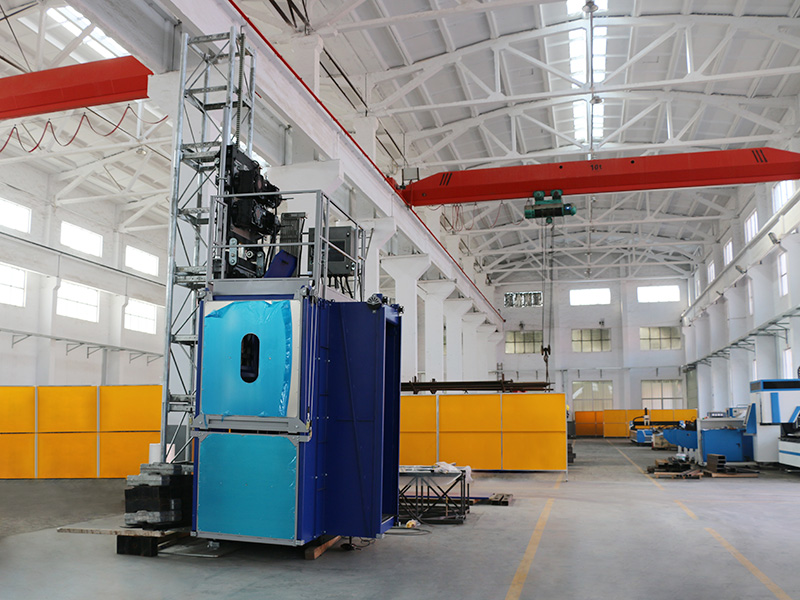
MH450 Material Hoist Commissioning: What Happens Before Your Construction Hoist Leaves The Factory
Key Highlights
Commissioning is the final quality gate before every
POWERSTON material hoist is shipped — covering mechanical verification, electrical safety checks, no-load and full-load testing, and documentation handover
The MH450 (TP/MH 450 series) covers payload from 1,000 kg to 4,000 kg, lifting heights up to 250 m, and dual speeds of 12/24 m/min
A single MH450 commissioning cycle includes drive calibration, safety device verification, and a signed test report before container loading
POWERSTON runs no-load and load tests on every unit using procedures that third-party inspectors (SGS, BV, TÜV) can witness during pre-shipment inspection
We plan to carry out commissioning of one material hoist on September 28. Once the commissioning is completed, this hoist will be arranged for delivery.
That single sentence, sent to customers after every order enters its final stage, conceals an entire chain of technical work. Commissioning is not a formality — it is the last controlled environment where every subsystem of a construction hoist can be verified before it leaves the factory and travels thousands of kilometres to a job site where a mistake cannot be undone.
Below is a practical look at what commissioning an MH450 material hoist actually involves, why each step matters, and how it connects to the delivery process that follows.
1. What the MH450 Material Hoist Is
The MH450 belongs to POWERSTON's TP/MH 450 series of transport platforms and material hoists. It is a rack-and-pinion vertical access machine designed for construction sites, where it moves materials — and optionally personnel — between ground level and elevated work floors.
1.1 Core Specifications
The series offers six standard configurations, from the TP/MH 450-1000S (1,000 kg, 1.6 × 3.2 m platform) to the TP/MH 450-4000T (4,000 kg, 3.2 × 1.6 m platform). All models share:
Tied lifting height: up to 250 m
Mast anchor interval: 6–7.5 m, first anchor at 3 m
Lifting speed: 12 m/min in passenger (TP) mode with hold-to-run controls; 24 m/min in material-only (MH) mode with ground station operation
Power supply: 380–480 V, 3-phase, 50/60 Hz
Drive configuration: 2 × 5.5 kW (smaller models) or 4 × 5.5 kW (higher payload models)
Dual-mode conversion: a key switch on the control panel converts between TP and MH modes, enabling the appropriate safety features for each
1.2 Where It Fits on a Project
MH450 Material Hoist are the vertical logistics backbone of any mid- to high-rise construction site. They transport pallets, mini loaders, prefabricated loads, kitchens, scaffolding, and large-dimension panelling to elevated floors — tasks that would otherwise consume crane time and slow the entire project schedule.
2. Why Commissioning Matters for a Material Hoist
A construction hoist is safety-critical equipment. It carries loads — and sometimes people — at height, in environments with dust, vibration, temperature swings, and unpredictable site conditions. The difference between a unit that performs reliably for years and one that generates service calls is almost always decided during commissioning, not during design.
2.1 Technical Verification
Every mechanical assembly — mast sections, drive unit, rack-and-pinion engagement, safety gear — is checked against the engineering drawing. Every electrical circuit — control voltage, motor phase sequence, earth continuity — is tested with instruments, not by eye.
2.2 Safety Validation
Overload protection, upper and lower limit switches, the falling brake (safety gear), door interlocks, and emergency stop circuits are each triggered individually to confirm they engage as designed. On a material hoist, the falling brake must arrest a free-falling platform within a defined distance; this is tested under controlled load conditions at the factory because it cannot be safely tested on site after installation.
2.3 Documentation Generation
The commissioning record becomes part of the machine's permanent file. It travels with the hoist to the customer, forms the baseline for the first site installation report, and is referenced by any future service technician who works on the unit.
3. The Commissioning Process Step by Step
A typical
MH450 commissioning at the POWERSTON facility follows a defined sequence. The exact order may shift slightly depending on the model and customer specification, but the core stages are consistent.
3.1 Stage One — Mechanical Assembly Verification
Before any power is applied, the mechanical build is inspected against the order configuration:
Mast section count and orientation (each section is marked and logged)
Rack-and-pinion mesh clearance on the drive unit
Platform cage alignment and guardrail integrity
Ground frame levelling via adjustable outriggers
Transport castor function and locking mechanism
Any deviation — a misaligned rack tooth, a loose guardrail bolt, an uneven ground frame — is corrected immediately. It is far cheaper to fix a mechanical issue on the factory floor than to ship a replacement part to a construction site in another country.
3.2 Stage Two — Electrical Wiring and Control System Check
The electrical cabinet on the MH450 platform houses the motor contactors, variable-frequency drive (where specified), control transformer, and safety relay chain. Commissioning verifies:
Correct phase sequence on the 380–480 V, 3-phase supply
Control circuit voltage (typically 24 V or 48 V DC derived from the main supply)
Continuity of every safety circuit: door interlocks, limit switches, emergency stop, overload relay
Proper earthing of the platform, mast, and ground frame
A wiring error at this stage can cause a motor to run in the wrong direction, a safety device to fail silently, or a control board to be damaged on first power-up. Every circuit is traced and signed off before the next stage begins.
3.3 Stage Three — No-Load Test
With the platform empty, the hoist is run through its full travel range at both speeds:
Smooth acceleration and deceleration at 12 m/min and 24 m/min
Correct operation of upper and lower limit switches — the platform must stop automatically before reaching the physical end of travel
Rack-and-pinion engagement quality: no abnormal noise, vibration, or skipping
Control response: start, stop, emergency stop, and direction change all function as expected
The no-load test is repeated several times. Any hesitation in the drive, any delay in brake engagement, or any irregularity in the rack-and-pinion interface is investigated and resolved before load is applied.
3.4 Stage Four — Load Test
This is the most critical stage. A calibrated test weight — typically 110% to 125% of the rated payload, depending on the applicable standard (EN 12158-1 / EN 12159 for European markets) — is placed on the platform, and the hoist is cycled through multiple up-and-down runs.
During the load test, the following are verified:
Motor performance: current draw, temperature rise, and torque under load
Brake holding: the platform must hold stationary at any point without creeping
Safety gear activation: triggered intentionally to confirm it arrests the platform within the specified distance
Overload protection: the system must refuse to start or must stop if load exceeds rated capacity
The load test generates the data that goes into the commissioning report: motor current readings, brake engagement distance, safety gear trigger point, and cycle count. This data is the machine's fingerprint.
3.5 Stage Five — Documentation and Packing Readiness
Once all tests pass, the commissioning dossier is compiled:
Commissioning test report with signed results for each stage
Electrical schematic (as-built, reflecting any configuration-specific wiring)
Operation and maintenance manual
Spare-parts list for the specific model
CE or EAC certificate (depending on destination market)
Loading photographs for the shipment record
The hoist is then cleared for packing and container loading.
4. From Commissioning to Delivery
The sentence "Once the commissioning is completed, this hoist will be arranged for delivery" covers a short but dense period:
4.1 Commissioning Day
Mechanical, electrical, no-load, and load tests are performed and documented. Minor adjustments, if any, are made on the same day.
4.2 Final Inspection and Packing
The unit is inspected once more, painted surfaces are touched up if needed, and the hoist is disassembled into transport modules: mast sections, drive unit, platform, ground frame, and parts cartons.
4.3 Container Loading
Components are loaded into a 20-foot or 40-foot container. Mast sections are bundled and strapped to pallets; the drive unit and platform are secured with wooden dunnage and lashings. Loading photographs are taken at three stages and sent to the customer.
4.4 Shipment
The container moves to the port (typically Shanghai or a nearby Yangtze River port for POWERSTON's Yixing facility), and the Bill of Lading, commercial invoice, packing list, and certificates are issued.
For a single MH450 unit, the entire cycle from commissioning to container departure is usually completed within one to two weeks.
5. What Buyers Should Verify at Destination
Commissioning at the factory does not eliminate the need for checks on site. When the MH450 arrives, the installer should:
Match bundles against the packing list before unwrapping anything
Inspect for transit damage — photograph any damaged cartons or deformed mast sections before signing the delivery note
Verify the commissioning report accompanies the machine and all test results are within specification
Re-test the safety gear after assembly on site, because the falling brake must be confirmed in the installed configuration
Confirm the electrical supply on site matches the machine's rating (380–480 V, 3-phase, 50/60 Hz) before first power-up
These steps are standard for any construction hoist installation, but especially important when the machine has travelled by sea for 30 to 45 days.
6. Why Factory Commissioning Reduces Total Cost of Ownership
It is tempting to view factory commissioning as a cost the manufacturer bears and passes on in the price. In practice, the opposite is true: every defect caught and fixed at the factory saves a multiple of that cost on site.
A safety gear that fails to engage during a factory load test costs a few hours of technician time to adjust. The same failure discovered after the hoist is installed on a 30-storey building can halt an entire construction programme, trigger an insurance investigation, and require a specialist service team to fly in with replacement parts.
For international buyers, the cost differential is even larger. A missing bolt or a miswired control circuit discovered during site commissioning in the Middle East, Southeast Asia, or South America can delay a project by days or weeks while the correct part is sourced and shipped.
7. Conclusion
The commissioning of an
MH450 material hoist on September 28 is not a single event but the culmination of the entire manufacturing process. It transforms a collection of machined, welded, painted, and wired components into a verified, safe, and documented piece of construction equipment ready for shipment.
For buyers ordering from POWERSTON or any comparable manufacturer, the commissioning report is one of the most valuable documents in the handover package. It is the proof that the machine worked correctly before it left the factory — and the baseline against which every future service intervention will be measured.
Once commissioning is complete, the hoist moves quickly into packing, container loading, and shipment. For a standard single-unit order, delivery arrangements are typically confirmed within days of the commissioning sign-off.
About POWERSTON: Wuxi Powerston Technology Co., Ltd. is a manufacturer of suspended platforms, building hoists, mast climbing platforms, and material hoists, based in Yixing, Wuxi, China. All products are CE and EAC certified. Contact: sales@powerston.com | +86-510-88782802