Elevator Installation Gondola: An Efficiency And Safety Assurance Device In Modern Elevator Construction
In modern elevator installation projects, traditional construction methods often face problems such as low efficiency and insufficient safety. As a lifting device specially designed for elevator installation scenarios, the elevator installation gondola is gradually becoming a core tool to improve construction efficiency and ensure operation safety. This article will detail the definition, composition structure, core advantages, and safe operation points of the elevator installation gondola to help you fully understand this modern construction equipment.
I. What is an Elevator Installation Gondola?
An
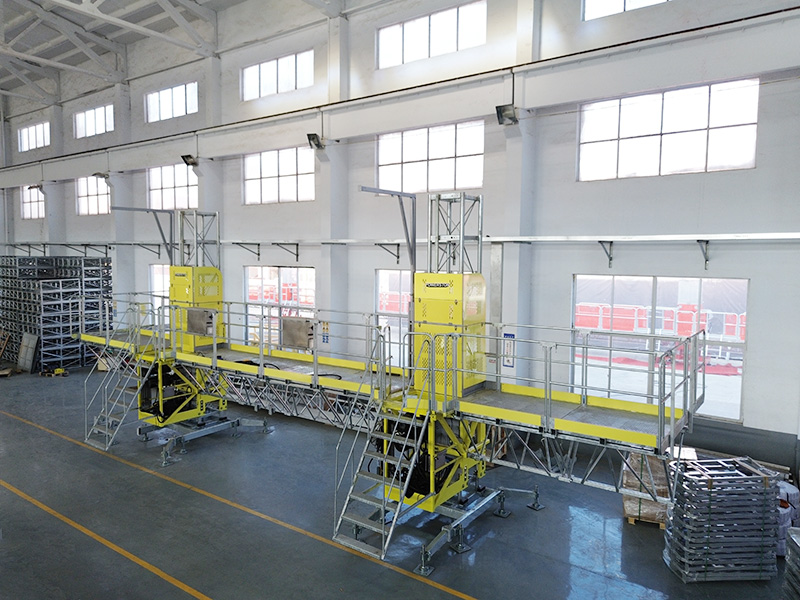
elevator installation gondola is a special lifting device used in the elevator installation process. Its main function is to provide a standing operating platform for construction workers and assist in transporting elevator components (such as guide rails, car parts, etc.). It realizes height adjustment through a mechanical lifting system and is suitable for installation scenarios of elevators with different floors and specifications. It is an important transitional equipment connecting traditional scaffolding and modern mechanized construction.
II. Main Components of the Elevator Installation Gondola
The stable operation of the elevator installation gondola relies on the coordinated work of various components, and its core components include the following key structures:
1. Frame
The frame is the basic support structure of the gondola, usually composed of at least four columns and several cross-braces, with a cross-section mostly quadrilateral or polygonal. This design ensures the overall stability of the equipment during lifting and can bear the weight of construction workers and components.
2. Hoist
Installed on both sides of the upper part of the frame, the hoist is the "power core" of the gondola, responsible for driving the equipment to lift. Through connection with the hanging beam, it controls the height adjustment of the platform to meet the installation needs of different floors.
3. Hanging Beam and Steel Wire Ropes
The hanging beam is located above the frame and is a key component connecting the hoist and the platform. Two types of steel wire ropes work together between the hanging beam and the hoist: the working steel wire rope bears the main lifting power transmission, while the safety steel wire rope serves as a backup protection, providing double security when the working steel wire rope is abnormal.
4. Operating Platform and Ladder
Two operating platforms, upper and lower, are set in the middle and lower parts of the frame, respectively for construction workers to stand and work, and for temporarily placing tools and components. The platforms are connected by a ladder to facilitate safe movement of personnel between platforms at different heights.
III. Core Advantages of the Elevator Installation Gondola
Compared with traditional construction methods such as scaffolding, the advantages of the elevator installation gondola are mainly reflected in the following three aspects:
1. Significantly Improve Construction Efficiency
Traditional scaffolding erection takes a lot of time and has low flexibility in height adjustment. The elevator installation gondola can quickly adjust the operating height through the mechanical lifting system, reducing the preliminary preparation time; at the same time, the platform can directly transport components, avoiding the cumbersomeness of manual handling and greatly shortening the overall construction period.
2. Multiple Safety Protection Designs
Safety is the core requirement of construction, and the elevator installation gondola fully considers this in design: it is equipped with a safety lock and a hoist pressure plate device. When the working steel wire rope breaks, relaxes, or malfunctions, the safety lock will immediately lock the safety steel wire rope to prevent the gondola from falling; the stable structure of the frame also reduces the risk of rollover, providing reliable protection for construction workers.
3. Adapt to Diversified Construction Scenarios
Elevator installation requirements vary greatly with different building structures and specifications. The elevator installation gondola supports "non-standard customization" and can adjust the structural design according to on-site construction difficulties (such as high-rise buildings, special-shaped shafts) or special scenarios (such as chimney ring installation, marine elevator installation, furnace inspection, etc.) to meet diversified construction needs.
IV. Safe Operation Points of the Elevator Installation Gondola
Although the elevator installation gondola has multiple safety designs, standardized operation is still the key to ensuring safety. The following points should be noted during use:
- Equipment Inspection is Indispensable: Before construction, a comprehensive inspection of the hoist operation status, steel wire rope wear, safety lock sensitivity, etc. is required to ensure no faults in all components;
- Personnel Training is a Prerequisite: Operators must receive professional training, be familiar with the equipment operation process, lifting control, and emergency braking methods, and it is strictly prohibited to work without a license;
- Emergency Plans are Necessary: An emergency plan should be formulated in advance. In case of sudden power failure, steel wire rope jamming, or other situations, the backup braking device should be activated immediately, and personnel should evacuate through the ladder or external rescue equipment to avoid panic operation.
Conclusion
Through scientific structural design, efficient lifting system, and multiple safety protections, the elevator installation gondola is redefining the construction standards of elevator installation projects. It not only solves the efficiency bottleneck of traditional methods but also provides protection for construction workers with the design concept of "safety first". In practical applications, only by strictly abiding by safety regulations and doing a good job in equipment maintenance can its value be fully exerted, promoting elevator installation projects to develop in a more efficient and safer direction.