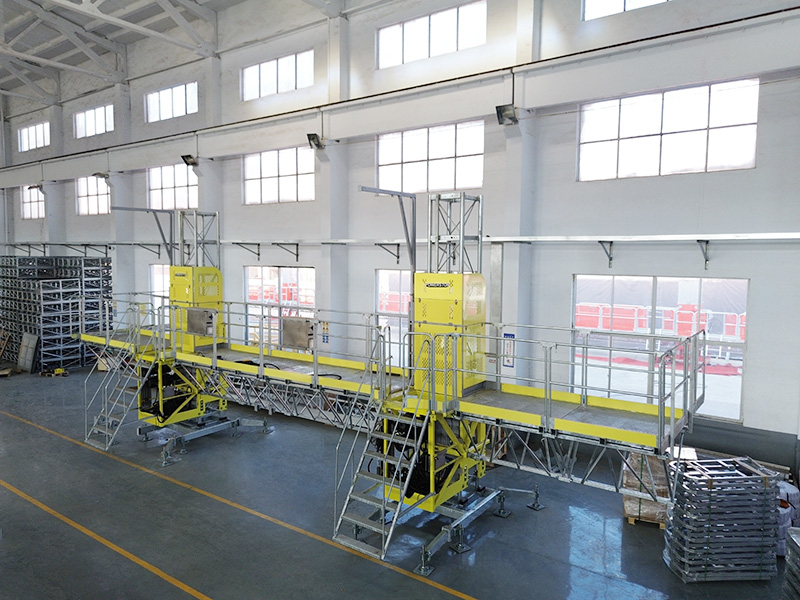
A Comprehensive Guide To Aerial Work Platforms: Types, Selection, Safe Use, And Maintenance
In modern construction, working at heights is a common challenge. Aerial work platforms, as efficient and flexible equipment for high-altitude operations, are widely used in scenarios such as building exterior wall painting, glass curtain wall or stone curtain wall installation. They are erected on buildings or structures through suspension mechanisms, with the suspension platform driven by a hoist and running along the facade via steel cables. Compared to traditional scaffolding, aerial work platforms offer significant advantages such as lower rental costs, no need for external scaffolding erection, and higher construction efficiency, making them an ideal choice for numerous construction projects.
Main Types of Aerial Work Platforms
Understanding different types of
aerial work platforms helps in making the best choice based on specific construction requirements:
Electric Aerial Work Platforms: Powered by electric motors, they are easy to operate, lift and lower smoothly, and have high work efficiency, making them one of the most widely used types currently.
Manual Aerial Work Platforms: Operated by human power, they have a relatively simple structure and lower cost, suitable for situations where work efficiency requirements are not high or electricity is inconvenient.
Rail-type Aerial Work Platforms: Run through a preset rail system, especially suitable for buildings with regular structures and continuous work surfaces, ensuring precise and stable operation.
Folding Aerial Work Platforms: Feature foldable characteristics, which can significantly save space during transportation and storage, making them particularly applicable in environments with limited workspace.
Special-purpose Aerial Work Platforms: Specifically designed for particular work requirements, such as electric welding work platforms, to meet the operating conditions of special trades.
Aerial Work Platform Selection Guide
When selecting an aerial work platform, multiple factors need to be comprehensively considered to ensure the equipment's applicability, safety, and economy:
Clarify Type Selection: The first step is to choose the most suitable platform type based on specific work requirements, building structure characteristics, and operating environment.
Prioritize Safety Performance: Safety is of paramount importance in high-altitude operations. It is essential to carefully inspect the quality and performance reliability of key safety components such as the platform's safety lock, limit device, and steel cables.
Evaluate Load Capacity: Based on the total weight of personnel, tools, and materials during operation, select a platform with sufficient load capacity; overloading is strictly prohibited.
Focus on Operational Convenience: Choose a platform with a user-friendly interface that is easy to learn and operate, while also considering the convenience of maintenance and upkeep of the equipment.
Reasonably Balance Price: On the premise of fully meeting safety performance and work requirements, compare multiple options to select a product with high cost-effectiveness and reasonable price.
Safe Use Specifications for Aerial Work Platforms
To ensure construction safety, the following safety operating procedures must be strictly followed when using aerial work platforms:
Operator Qualifications: Operators must undergo professional safety technical training, pass assessments, and obtain corresponding qualification certificates before working with a license.
Comprehensive Pre-use Inspection: Before each use of the platform, a thorough and detailed inspection must be conducted on the suspension platform, suspension mechanism, hoist, safety lock, steel cables, electrical system, etc., to ensure all components are intact and function properly.
Correct Wearing of Safety Protection: During the operation of the platform, operators must wear a qualified safety belt throughout and securely fasten it to an independent safety rope or a firm part of the building.
Prohibition of Overloading: Strictly use the platform in accordance with its rated load capacity; overloading is strictly prohibited, including the total weight of personnel, tools, and materials.
Dedicated Supervision System: During the use of the platform, a dedicated person must be arranged on the ground for supervision to promptly detect and handle any potential abnormal situations.
Key Maintenance Points for Aerial Work Platforms
Regular maintenance is crucial to ensuring the long-term safe and stable operation of aerial work platforms and extending their service life:
Regular Cleaning: Keep the platform surface clean, promptly removing dust, oil, and debris to prevent corrosion.
Component Inspection: Regularly inspect the wear and breakage of steel cables, the sensitivity and reliability of safety locks, the accuracy of limit devices, and the tightness of various connection parts.
Lubrication Maintenance: Add lubricants to various moving parts of the platform, such as the hoist and guide wheels, in accordance with the instructions to ensure flexible operation.
Safety Inspection and Testing: Regularly hire professionals to conduct comprehensive safety performance inspections and necessary tests on the platform to timely identify and eliminate potential safety hazards.
Summary
Aerial work platforms play an indispensable role in modern construction with their unique advantages. To ensure construction safety and efficiency, when purchasing aerial work platforms, factors such as type, safety performance, and load capacity should be fully considered; in daily use, safety operating procedures must be strictly followed, personnel training and on-site supervision should be strengthened; at the same time, a sound maintenance system should be established to regularly inspect and maintain the equipment. Only in this way can the effectiveness of aerial work platforms be maximized, the life safety of construction personnel be guaranteed, and various high-altitude operation tasks be successfully completed.