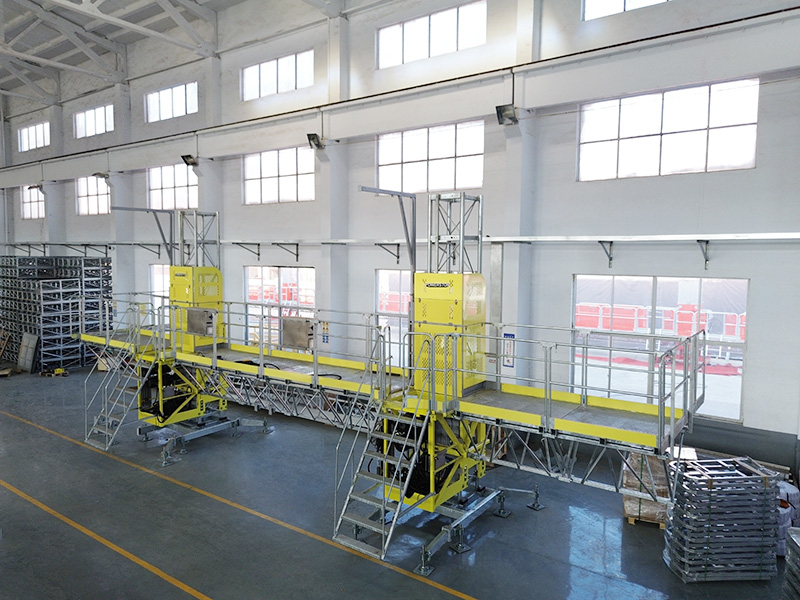
Aerial Work Platforms: Professional Solutions For Enhanced Efficiency And Safety
In modern construction, maintenance, and numerous industrial fields, working at height is a common yet challenging task. Traditional scaffolding or manual ladders are not only inefficient but also accompanied by high safety risks. Aerial work platforms, as mechanical equipment specifically designed for working at height, have become the ideal choice for addressing various high-altitude installation, construction, maintenance, and cleaning needs by safely and efficiently lifting personnel, tools, and materials to designated heights. Their application range is extensive, covering multiple industries such as building construction and renovation, power facility maintenance, communication equipment installation, urban cleaning, advertising installation and maintenance, media photography for large events, and logistics warehousing.
What is an Aerial Work Platform?
An
aerial work platform, simply put, is a specialized machine that provides a stable working platform and can lift workers and related equipment to specific heights. It achieves lifting, telescoping, rotating, and other movements through hydraulic, electric, or mechanical drive systems, thereby meeting work requirements at different heights and spatial positions. Compared to traditional climbing tools, aerial work platforms have achieved a qualitative leap in terms of safety, efficiency, and flexibility.
Common Types of Aerial Work Platforms and Their Application Scenarios
Aerial work platforms can be divided into various types based on their structural characteristics and functional focuses to adapt to different working environments and needs:
Scissor Lift Aerial Work Platform: Its core structure adopts a scissor-type hydraulic lifting mechanism, featuring good stability, strong load-bearing capacity, and fast lifting speed. The working platform area is relatively large, suitable for multiple people working simultaneously. Due to its structural characteristics, the working radius is usually limited after reaching a certain height, so it is more suitable for indoor flat ground or outdoor places with solid foundations, such as factory equipment installation, warehouse shelf access, shopping mall ceiling maintenance, and other scenarios with high requirements for vertical lifting.
Boom Lift Aerial Work Platform (Straight Boom): Equipped with one or more telescopic straight booms, it can achieve a large range of horizontal extension and vertical lifting. It has a large working radius and a high working height, suitable for scenarios that require crossing certain obstacles or working within a large working radius, such as large venue construction, bridge inspection, outdoor billboard installation, etc.
Articulating Boom Lift Aerial Work Platform: Possessing a multi-section foldable "articulating boom" structure, combining rotation and telescoping functions, it can usually achieve 360-degree full rotation. Its movements are flexible, enabling it to easily cross obstacles and reach complex positions, suitable for working in multi-angle, irregular spaces, such as building facade decoration, street lamp maintenance, garden tree pruning, etc.
Mast Type Aerial Work Platform: Usually adopts a single or double mast structure, characterized by light weight, compact structure, and stable lifting. It can reach a relatively high working height, and the working platform is relatively small. Suitable for high-altitude operations in narrow indoor and outdoor spaces, such as high-altitude cleaning and maintenance of airport terminals and large shopping malls, as well as some installation work requiring high operational precision.
In addition to the above structural classifications, aerial work platforms are also divided according to their movement methods and power sources, such as self-propelled (with its own power, flexible operation), trailer-mounted (requiring vehicle traction for movement), vehicle-mounted (installed on a truck chassis, suitable for long-distance transfer), etc. These characteristics further expand the flexibility of their applications.
Core Advantages of Using Aerial Work Platforms
Choosing aerial work platforms instead of traditional climbing methods can bring significant advantages to operations in multiple aspects:
Significantly Enhanced Operational Safety: Aerial work platforms are equipped with comprehensive safety protection devices, such as anti-fall safety locks, safety belt attachment points, platform guardrails, emergency stop buttons, overload protection, and limit devices. These fundamentally reduce the risks of falling from heights and tipping over, providing a solid guarantee for the life safety of workers.
Greatly Improved Operational Efficiency: Aerial work platforms can quickly transport personnel and equipment to the designated height, with convenient operation, reducing the time spent on building and dismantling traditional scaffolding. Their flexible mobility and operational performance also make the transition between different work points more efficient, thereby effectively shortening the overall construction period.
High Operational Flexibility: As mentioned earlier, different types of aerial work platforms are designed for different working environments and needs, and can adapt to various complex working conditions such as indoor, outdoor, narrow spaces, and obstacle crossing, meeting diversified high-altitude operation requirements.
Help Reduce Comprehensive Costs: Although aerial work platforms have a certain initial investment, from a long-term and comprehensive benefit perspective, they can significantly reduce reliance on a large number of labor, lowering labor costs; at the same time, they reduce the consumption and rental costs of materials such as scaffolding, and bring indirect cost savings due to shortened construction periods, thereby achieving a reduction in overall operation costs.
Safety Guidelines for Using Aerial Work Platforms
Although aerial work platforms are highly safe, the safe operation of any mechanical equipment is inseparable from standardized operation and management. To ensure operational safety, the following safety guidelines must be strictly followed:
Comprehensive Inspection Before Operation: Before each use, a detailed inspection of the aerial work platform must be conducted. This includes, but is not limited to: checking for any external damage, ensuring normal tire pressure (if wheeled), checking for hydraulic system leaks, ensuring all connecting parts are tight, verifying that the electrical and control systems are normal, and confirming that safety devices (such as safety belts, limiters) are intact and effective.
Operator Qualification Requirements: Operators must receive professional safety technical training, be familiar with the performance, operation methods, and emergency response measures of the equipment they operate, and obtain the corresponding operation qualification certificate before taking up the post. Unauthorized operation or operation by non-designated personnel is strictly prohibited.
Startup and Trial Operation: Start the platform correctly in accordance with the equipment operation procedures. Before formal operation, an empty-load trial run should be conducted to check whether all movements (lifting, telescoping, rotating, etc.) are smooth, whether the braking is reliable, and confirm that the equipment is operating normally.
Safety Regulations During Operation: After boarding the platform, workers must fasten their safety belts immediately and ensure that the safety belts are firmly connected to the safety attachment points of the platform. During operation, attention should be paid to not exceeding the platform's rated load capacity, no roughhousing or jumping on the platform, and avoiding sudden movements or unbalanced loading. Always pay attention to the surrounding environment and stay away from hazardous sources such as overhead power lines.
Precautions After Operation: After completing the work, the platform should be lowered to the lowest position, the power supply should be turned off, and tools and debris on the platform should be cleaned up. Perform daily maintenance on the equipment as required, such as cleaning, checking lubricating oil levels, tightening loose parts, etc., and fill out the equipment operation record.
Factors Influencing the Price of Aerial Work Platforms
The price of aerial work platforms varies due to multiple factors and cannot be generalized. The main influencing factors include the type of platform (scissor lift, straight boom, articulating boom, mast type, etc.), maximum working height, rated load capacity, power type, operational performance (such as whether it is self-propelled, whether it has rotation function), and brand. Generally speaking, scissor lift aerial work platforms with relatively simple structures and basic functions will have a relatively affordable price, while large mast-type or special boom-type aerial work platforms that can reach extremely high working heights and have complex movement functions will have a relatively higher price. If you have specific procurement or leasing needs, it is recommended to consult professional equipment suppliers or authorized dealers, who can provide more accurate product information and quotation plans based on your actual work requirements.
Summary
As a key equipment for modern high-altitude operations, aerial work platforms, with their excellent safety, efficiency, and flexibility, are playing an increasingly important role in high-altitude work scenarios across various industries. They not only greatly improve working conditions and ensure the life safety of workers but also significantly enhance work efficiency, creating greater value for enterprises. When selecting and using aerial work platforms, fully understanding their type characteristics, clarifying one's own needs, and strictly abiding by safe operating procedures are prerequisites for ensuring the smooth, safe, and economical completion of operations. With the continuous advancement of technology, aerial work platforms will develop towards a more intelligent, environmentally friendly, and efficient direction, continuously providing better solutions for high-altitude operations in various industries.