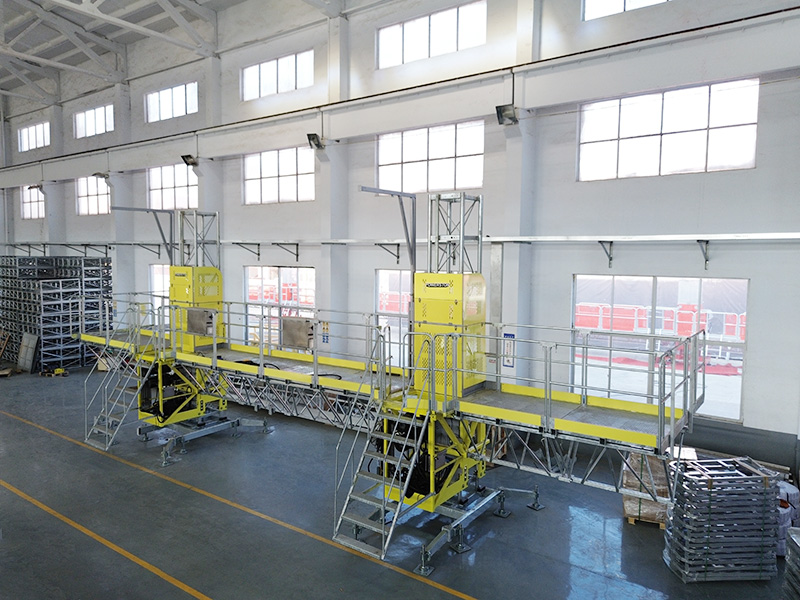
Complete Guide To Lifting Tools: Types, Application Scenarios, And Safe Usage Guidelines
In industrial production, construction, warehousing, and logistics, lifting tools are core equipment that enhances operational efficiency and ensures personnel safety. They enable the rapid movement of materials by vertically or horizontally displacing heavy loads, making them particularly suitable for intermittent work scenarios. Selecting appropriate lifting tools not only reduces labor costs but also effectively prevents safety accidents. This article details common types of lifting tools, their application scenarios, and key safe usage points to help you comprehensively understand and correctly utilize these devices.
I. What Are Lifting Tools?
Lifting tools are material handling devices used to hoist or jack up heavy loads, characterized by intermittent operation modes and vertical/horizontal movement capabilities. Structurally, most lifting tools include a lifting mechanism, and lifting accessories typically use steel ropes, chains, or rigid jacking components. Whether for large-scale lifting on construction sites, material transfer in factory workshops, or cargo stacking in warehouses, lifting tools play an irreplaceable role.
II. Common Types of Lifting Tools and Their Application Scenarios
Different lifting tools suit varying operational needs. Below are 8 common types and their characteristics:
1. Cranes
Cranes are the "all-rounders" of lifting tools, primarily used for vertically lifting and horizontally moving heavy loads across large operational areas. They encompass diverse types, including tower cranes (for high-rise lifting on construction sites), mobile cranes (flexible for temporary operations), and overhead cranes (fixed on tracks for factory workshops). Capable of efficiently handling steel beams, large equipment, or bulk materials, cranes are core equipment in construction and manufacturing.
2. Jacks
Jacks are small yet practical jacking tools designed for short-distance lifting of heavy objects, commonly used in auto repair and equipment maintenance. They are categorized by working principle into hydraulic jacks (utilizing fluid pressure for strong lifting force) and mechanical jacks (using screws or levers for simple operation). Always ensure stable placement during use to prevent hazards from load tilting.
3. Winches
Winches excel at pulling or lifting loads by winding cables or ropes around a drum, driven manually or by motors. They are ideal for moving large objects, such as boat docking, vehicle recovery, and heavy equipment transfer, performing exceptionally well in remote or off-grid environments.
4. Forklifts
Forklifts are the "workhorses" of warehousing and logistics, designed specifically for handling and stacking palletized goods. Their forks slide under pallets to easily lift and move loads, operating flexibly in tight spaces. Forklifts significantly boost efficiency in warehouse turnover and workshop material transfer.
5. Overhead Cranes
Overhead cranes are fixed on tracks in large factories or warehouses, suitable for long-distance, precision heavy-load. Operated internally or remotely, they are used to transport steel beams, engines, and other large components, particularly in production lines or assembly workshops with continuous operations.
6. Gantry Cranes
Gantry cranes feature independence from fixed structures, supported by a bridge and legs on wheels or tracks for ground mobility. Widely used in shipyards, large factories, and container terminals, they handle oversized loads like machinery and containers with flexible operational ranges.
7. Pallet Trucks
Pallet trucks are ideal for short-distance movement of pallets and boxes in warehouses, available in manual and electric models. They lift loads slightly off the ground for easy rolling, reducing manual labor for frequent transfers of medium-weight goods.
8. Conveyor Systems
Conveyor systems use belts, rollers, or other mechanisms to continuously transport items (e.g., boxes, parts, packages) in factories or warehouses without manual intervention. They automate material flow between processes or areas, significantly improving productivity and reducing manual handling injuries.
III. Lifting Tool Selection Guide: How to Choose the Right Equipment for the Scenario
Selecting lifting tools requires considering three key factors: operational scenario, load characteristics, and environment:
- Working Height: Use boom lifts or tower cranes for high-altitude tasks (e.g., building facade construction); opt for forklifts or pallet trucks for ground-level or low-rise work.
- Space Constraints: Prioritize forklifts or pallet trucks for narrow spaces (e.g., warehouse aisles); choose gantry cranes or mobile cranes for open areas (e.g., shipyards).
- Load Type: Forklifts or pallet trucks for palletized goods; overhead cranes for large components (e.g., engines); gantry cranes for ultra-heavy loads (e.g., containers).
- Movement Distance: Pallet trucks or winches for short distances; conveyor systems or overhead cranes for long-distance or continuous transport.
IV. Key Safety Guidelines for Lifting Tools: Rules to Remember
Lifting operations involve heavy loads, making safety paramount. Follow these critical guidelines:
1. Equipment Inspection: Before use, check for wear on lifting accessories (steel ropes, chains) and ensure brake systems are functional to avoid (operation with faults).
2. Personal Protective Equipment: Operators must wear gloves, helmets, and safety boots; secure long hair to prevent entanglement.
3. No Overloading: Strictly adhere to rated load limits to avoid equipment damage or load.
4. Standardized Operation: Only trained personnel may operate lifting equipment; complex tasks require dedicated to ensure clear signals.
V. Conclusion: Lifting Tools – A Dual Guarantee of Efficiency and Safety
Lifting tools are the "blood vessels" of industrial production and logistics. Selecting and using them correctly enhances efficiency while protecting personnel. Whether cranes on construction sites, forklifts in warehouses, or conveyor systems in workshops, each device offers unique value. Remember: Choose equipment based on the scenario and strictly follow safety rules to make lifting tools reliable assistants in production.
We hope this article helps you understand lifting tool types and applications. To further optimize workflows, start by selecting the right lifting equipment.